Physical Science - Earth's Surface Environments
GEOG 1000-008
Instructor: Bill Spiva
Fall 2010 Semester
Part I: Tracking Earthquakes
Most of Earth's earthquakes occur along tectonic plate boundaries or subduction zones (where one plate dives underneath the other). This ePortfolio assignment taught us to track earthquakes along different plate boundaries. Below are listed one earthquake of 4.0 magnitude or higher at each type of plate boundary along with other useful information. Additional information and videos can be found on National Geographic's Website.
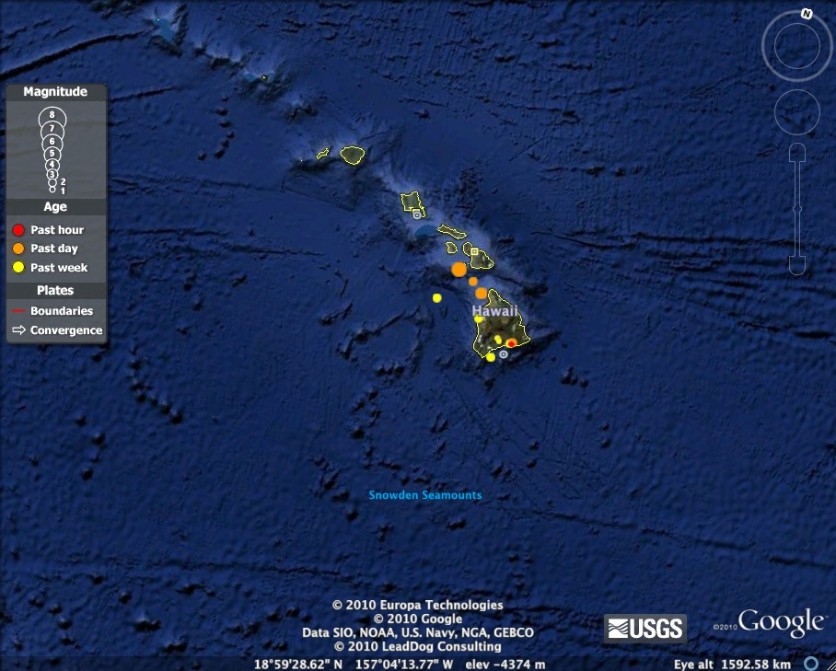
1. A 5.1 magnitude earthquake, with a focus depth of 17.70 km struck near Maui, Hawaii on Tuesday, November 23rd, 2010 at 6:34 P.M. local time. This earthquake occurred near a oceanic-oceanic plate boundary. These boundaries occur where two oceanic plates have volcanic activity, and sometimes create chains of islands- like the beautiful Hawaii.
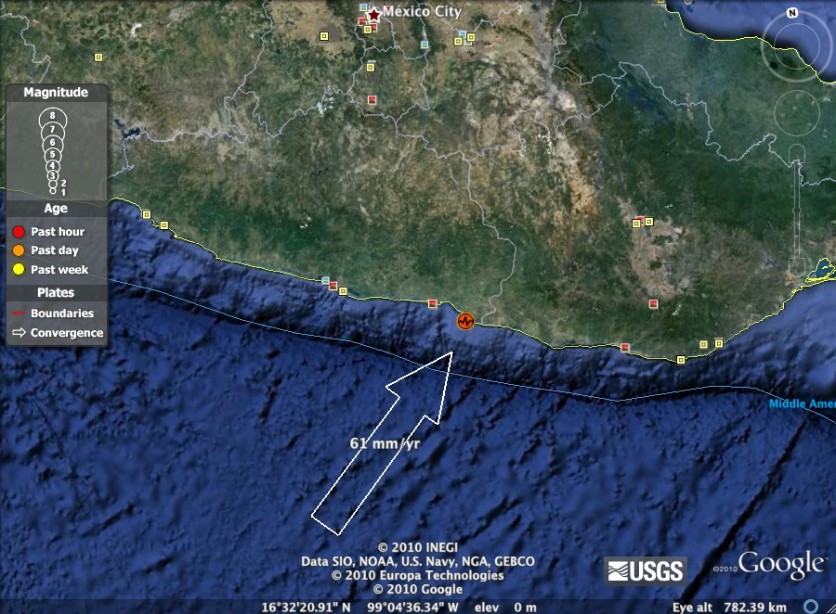
2. A 5.0 magnitude earthquake, with the focus depth of 22.80 km struck near the coast of Guerrero, Mexico on Wednesday, November 24th 2010 at 8:01 A.M. local time. This earthquake occurred near a oceanic-continental plate boundary where we see volcanic activity between oceanic and crustal plates that collide.
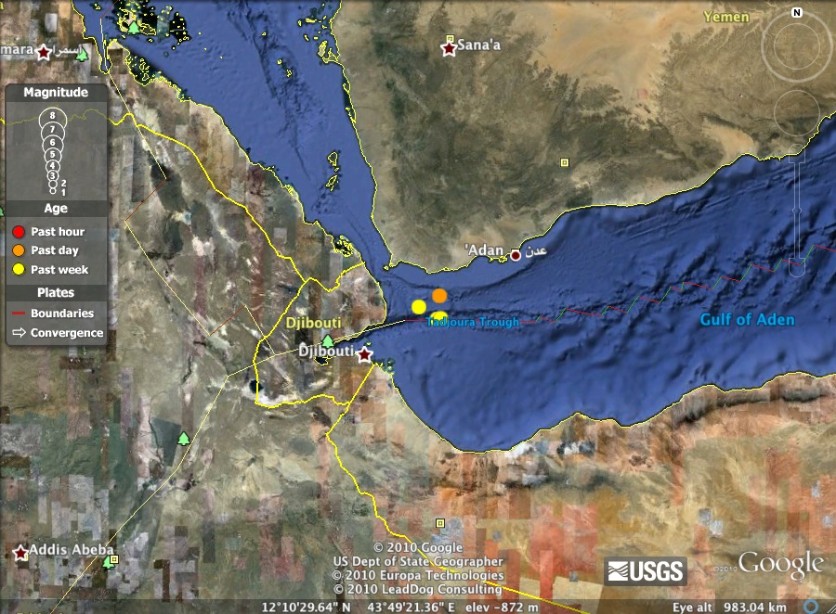
3. A 4.9 magnitude earthquake, with the focus depth of 10.10 km struck near the coast of Yemen on Monday, November 22nd, 2010 at 1:26 A.M. local time. This earthquake occurred at a divergent boundary, where we find plates spreading apart- creating new crust.
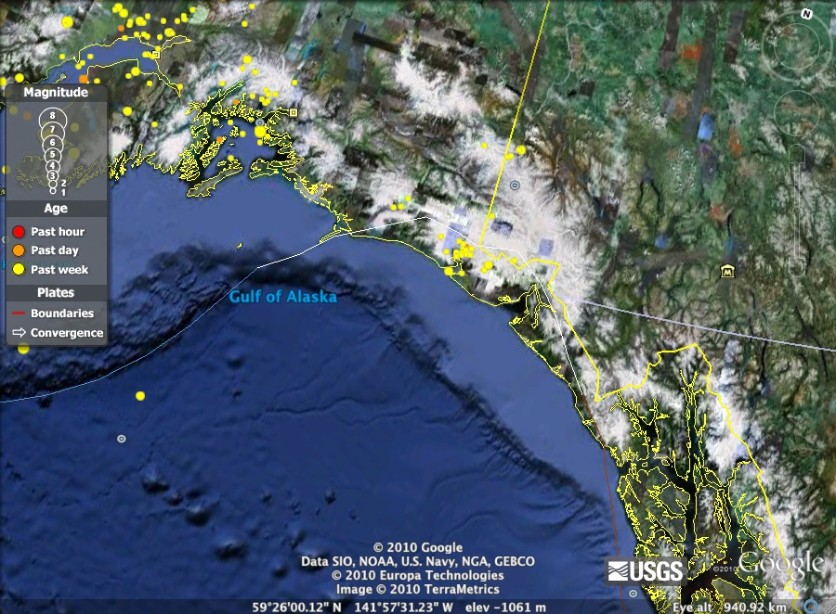
4. A 4.5 magnitude earthquake with a focus depth of 16.0 km struck in Southern Alaska on Thursday, November 18th, 2010 at 6:24 P.M. local time. This earthquake occurred on a Transform Plate, where we witness a fault that runs along the boundary of a tectonic plate.
Part II: Tracking Volcanos
The majority of volcanos are also found along plate boundaries, specifically in subduction zones where one plate dives underneath another, forcing rapid melting of molten material- creating a volcano. The Ring of Fire is the most volcanically populated area on Earth, found where the Pacific Plate sub ducts underneath it's surrounding plates. In this portion of our ePortfolio assignment, we track volcanos. Below are the 4 main types of volcanos and an image of the geographic features. Additional information can be found on National Geographic's Website.
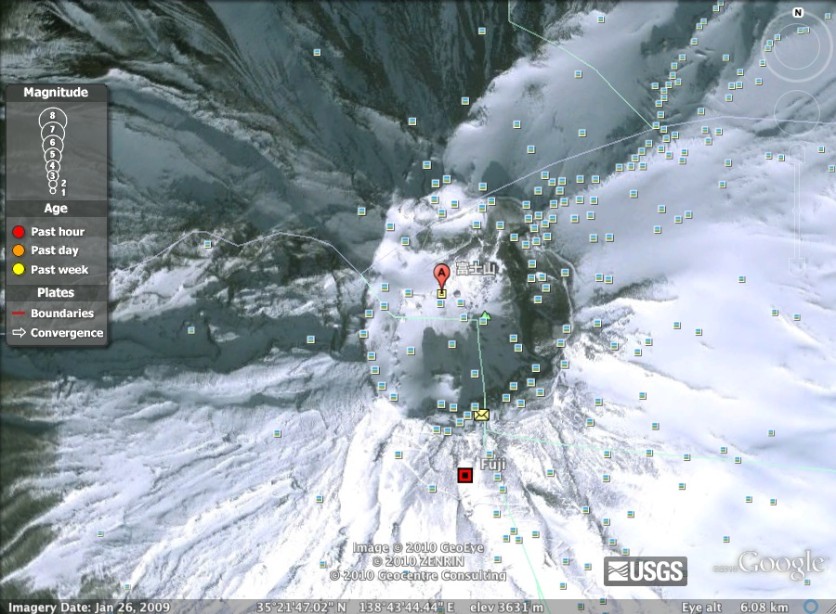
1. At Mount Fuji in Japan, we see a composite volcano. Mount Fuji is located at the triple junction where the Amuiran Plate, Okhostk plate, and the Philippine Sea plate meet- it is on a continental convergent plate.
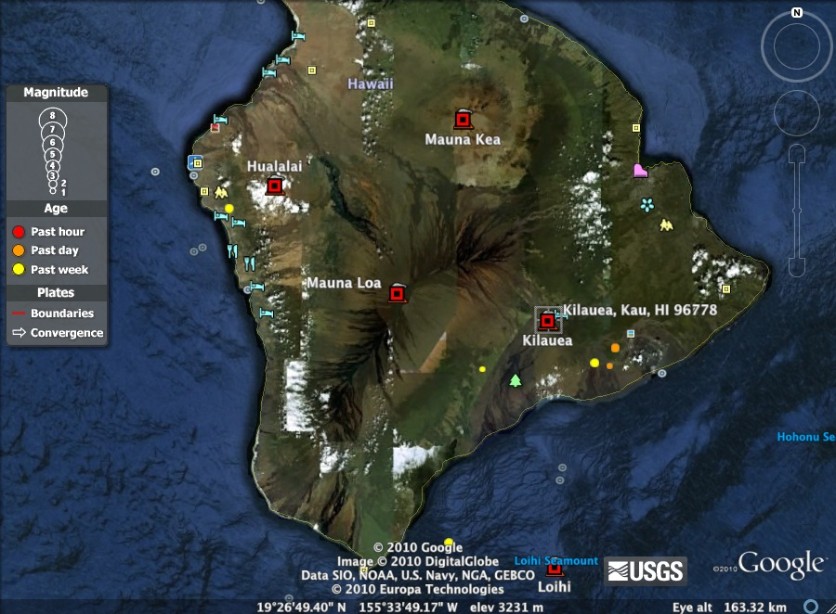
2. We find a shield volcano in Hawaii, which is a Hot Spot area, named Mauna Loa Volcano. This specific volcano, located on a Hawaiian island, is the single largest volcano on Earth, in terms of volume, and estimated 18,000 cubic miles, and area.
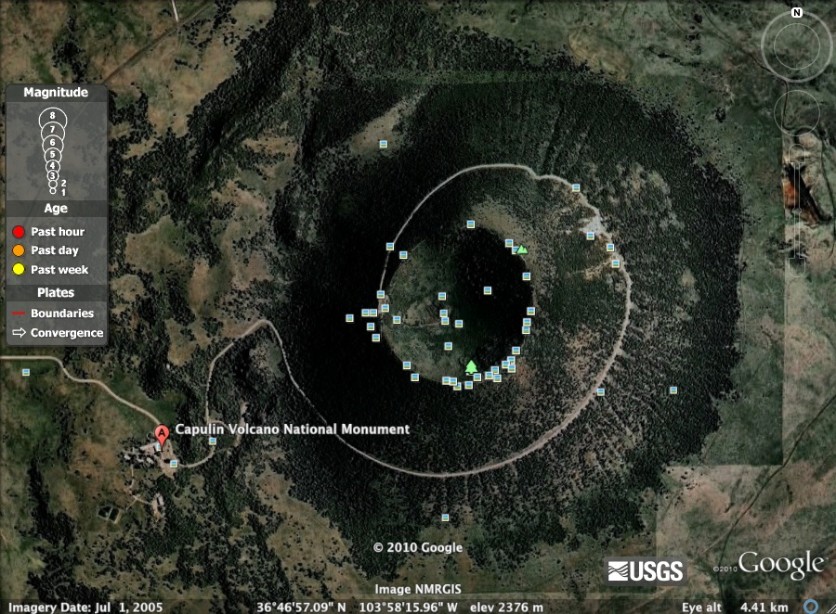
3. Located in New Mexico, Capulin Volcano is a traditional cinder cone volcano. It lies on a divergent plate boundary. A cinder cone volcano is a steep conical hill of volcanic fragments, with a bowl-shaped crater for it's summit.
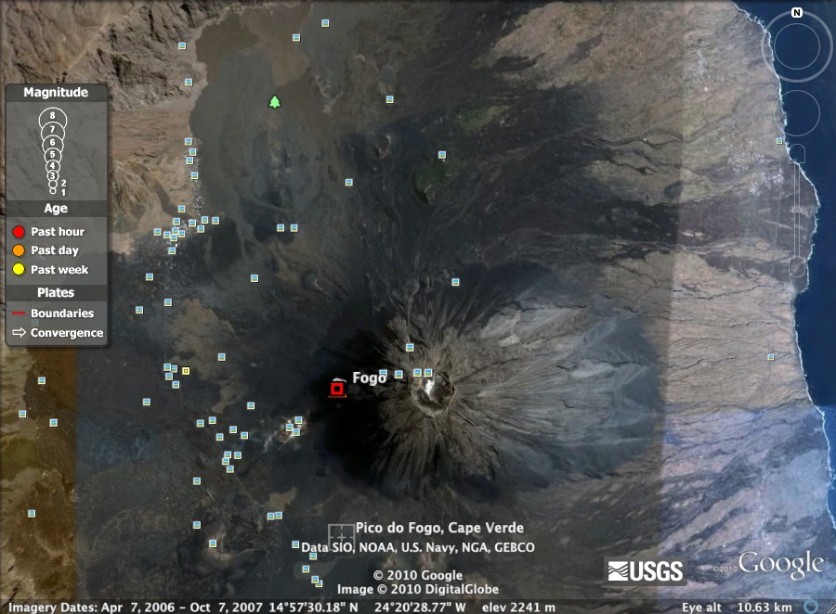
4. Mount Fogo, on the island of Cape Verde located in the southern part of the Atlantic Ocean is a Caldera. Calderas are formed by a cauldron-like deposit of Magma underneath collapsed land following a volcanic eruption. This caldera sits on a oceanic-oceanic plate boundary.
Reflection On My Work
In terms of plate tectonics, there is a direct correlation between volcano placement and earthquake activity. The Earth's surface is formed of massive slabs of rock, also called plates, that are always moving. These sometimes slide past one another, but at other times collide. This movement of the plates builds up tremendous quantities of energy in the rock, and when energy is released, it give off vibrations, and also releases molten magma in hidden chambers underneath the Earth's surface, relating volcanos and earthquakes. Sometimes, we see earthquakes occur pretty simultaneously in the same areas where seismic plate activity occurs. This picture depicts the areas in which we see seismic activity on the Earth's surface, and also 'The Ring of Fire' where most of the volcanos in the world are located. (The surrounding area of the Pacific Plate)

In reference to the spacial relationship and distribution that resides within these two forces of nature we have discussed, we can see in the picture that in the area around the pacific plate is where most of the activity goes on, especially for volcanos. We see earthquakes in most areas of the world, but especially within the miles surrounding the plate boundaries. These plate boundaries are susceptible to seismic activity because of the sliding and colliding between one plate and another. The close relationship between earthquakes and volcanoes is evident from the maps depicting the locations prone to both phenomena. If you compare the maps that illustrate earthquakes zones and volcanic zones, you will find them matching to each other. The main theory behind both these natural calamities lie in the theory of Plate Tectonics. Similar to earthquakes, volcanism or volcanic activity is observed when the plates are divergent, or move apart, or convergent, which is moving towards each other. In such plate movements, the magma presents in the plate boundaries may rise to the Earth's surface, leading to volcanic eruptions. Divergent plates may cause long volcanic rifts, whereas convergent plates result in individual eruptions.
I Have Learned...
Resulting in all of this information I have provided, I have learned an astronomical amount about seismic activity and earthquakes and how they are related and differentiate from volcanoes. I found it very informative that there are specific types of plates reactions when the theory of Plate Tectonics is applied. Subduction, Convergence, DIvergence, and so on... where plates actually dive underneath each other, creating molten hot magma underneath the Earth's surface. Those molten chambers erupt, creating new land continuously and changing the Earth's surface continuously throughout history.
Also, The earthquake size is represented by moment magnitude scale, or the MMS. A magnitude 3 or lower is undetectable, whereas a magnitude 7 or greater causes maximum damage to property, buildings, and life on Earth. Volcanos can occur in any part of the Earth's surface, either in land or seas and oceans. Volcanoes are classified into active (or eruptive), dormant (not active at the present time), and extinct (not erupting) types. They are classified in six different types furthermore- shield, cinder, submarine, subglacial, stratovolcano, and super volcano, which all depends on the way the material is ejected and other features of the volcano.